I was sitting in front of my desk when the Curaçao story really hit me.
Not in the dramatic way people pretend things hit them online. No slow music. No goosebumps immediately. Just me, laptop open, scrolling through the details of their qualification, watching clips, checking the group, reading the numbers again and again.
Population: about 156,000.
Smallest nation ever to qualify for a men’s World Cup.
And I just sat there for a second thinking, wait, this actually happened?
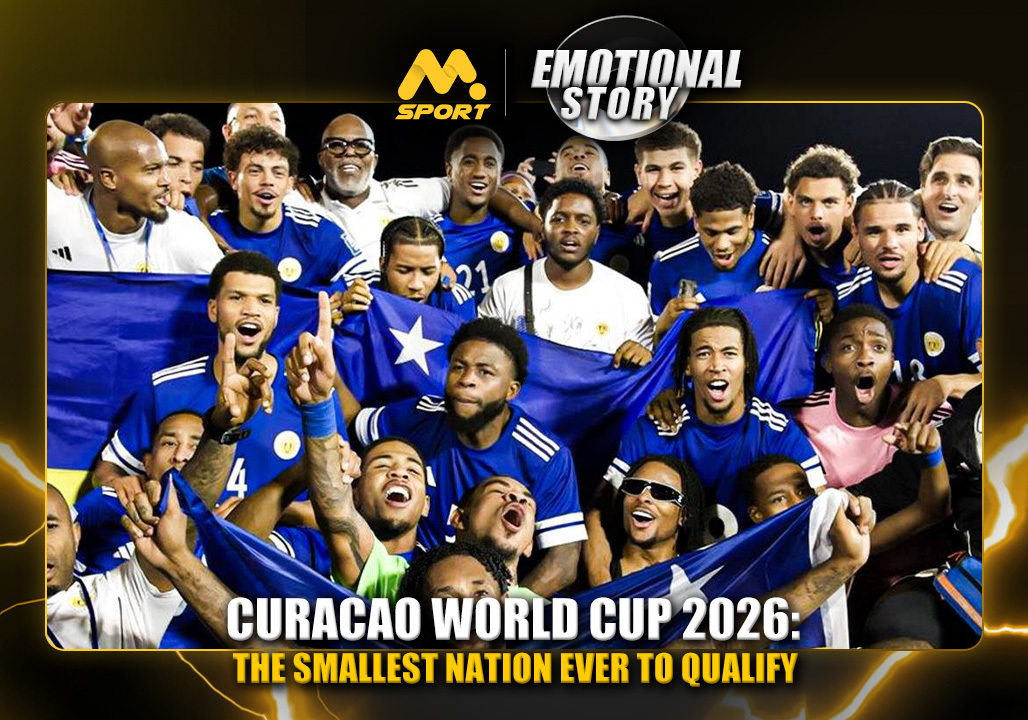
Because sometimes football gives you a story that feels too clean to be real. A tiny Caribbean island. A veteran coach. A tense final qualifier away from home. A goalless draw in Jamaica. A late VAR scare. Then the whistle. Then history.
Curaçao are going to the 2026 World Cup.
That sentence still sounds strange, but in the best way possible.
We have become used to World Cup stories being built around the usual giants. Brazil. Argentina. Germany. France. England. Spain. The countries with the big names, big leagues, big expectations and big pressure. Even before the tournament starts, we already know the conversations. Who is winning it? Is this Messi’s last-last dance? Can Mbappé take over the world again? Will England finally stop turning hope into heartbreak?
Then Curaçao arrive and remind you why the World Cup still matters.
Not because they are expected to win it. Not because they have a superstar who will dominate every billboard. Not because they are about to become everyone’s tactical obsession.
They matter because they are proof that football still has room for the impossible.
This is a country smaller than many cities. Smaller than the crowds that will fill some of the stadiums they are about to play in. There are clubs in Europe with fanbases many times bigger than Curaçao’s entire population. Yet somehow, this island has done what so many bigger football nations have never done.
They qualified.
And they did not qualify by accident. That is the important part.
Curaçao were unbeaten in the final round of Concacaf qualifying. They finished top of their group. They went to Jamaica needing a result and survived one of those matches where every clearance feels like a life decision. Jamaica pushed. The crowd pushed. The pressure pushed. Then came that late penalty drama, the kind of moment that can either ruin a country’s dream or become part of the legend.
VAR said no penalty.
Curaçao held on.
Football can be cruel, but every now and then, it chooses romance.
The easy thing would be to talk about Curaçao like a cute story. The small team. The happy underdog. The country everyone will clap for before the “real” football begins. But that would be lazy. It would also be unfair.
They are not just going to the World Cup because their story is nice. They are going because they earned the right to stand there.
That is what makes it powerful.
Dick Advocaat, somehow, is part of this too. Football has a funny way of recycling old characters and giving them one more final scene. Advocaat has coached everywhere, seen everything, and probably forgotten more football than most of us will ever know. At this stage of his life, he could have simply been a respected old name in football history.
Instead, he helped take Curaçao to their first World Cup.
There is something beautiful about that. A small nation and an old coach meeting at the perfect time. One chasing a dream it had never touched before. The other getting one more reminder that football can still surprise you, even after decades in the game.
Then you look at the players and the story becomes even more interesting.
Curaçao’s team carries that Dutch-Caribbean connection. Some players were born in the Netherlands. Some have roots tied deeply to the island. Many grew up in different football systems, different dressing rooms, different worlds. But for this campaign, they became one thing.
Curaçao.
That is what international football does when it is at its best. It turns geography into emotion. It turns ancestry into responsibility. It turns a flag into something you can feel in your chest.
Now imagine what this means for the island itself.
Imagine being a child in Willemstad, watching your country walk out at the World Cup. Not Brazil. Not the Netherlands. Not Argentina. Your country. Your people. Your flag. Your anthem. The place you know, the streets you recognize, the accent you hear at home, suddenly standing on the biggest football stage in the world.
That is bigger than sport.
That is memory.
And the funniest part is that Curaçao’s reward for this miracle is absolutely brutal.
Germany. Ecuador. Côte d’Ivoire.
Welcome to the World Cup, here is a four-time champion, a dangerous South American side, and one of Africa’s most talented teams. No soft landing. No gentle introduction. Just straight into the deep end.
But maybe that is perfect.
Because what are Curaçao supposed to be afraid of now?
They have already done the thing nobody expected. They have already made history. They have already turned a qualifying campaign into a national fairytale. Nobody is asking them to win the World Cup. Nobody is asking them to outplay Germany for 90 minutes. Nobody is asking them to become something they are not.
They just have to be Curaçao.
Organized. Brave. Annoying to play against. Proud. Free.
That is the beauty of underdogs at the World Cup. They do not always need to win to leave a mark. Sometimes they just need one goal. One save. One tackle. One night where the world suddenly learns their name properly. One moment where the camera cuts to their fans and you realize this is not content, this is somebody’s entire life exploding with joy.
The 2026 World Cup will be massive. Forty-eight teams. Three host countries. Endless debates about whether expansion has made the tournament better or weaker. There will be people complaining about quality. People complaining about format. People complaining because football fans are never happier than when they have something to complain about.
But Curaçao are the best argument for expansion.
They are not a gimmick. They are not charity. They are not there to decorate the tournament.
They are the reason you open the door wider.
Because when you open the door wider, a country of 156,000 people might walk through it and make the whole world stop for a second.
That is why this story stayed with me at my desk.
I started by reading about a small nation qualifying for the World Cup. I ended up thinking about what football is supposed to feel like.
Hopeful. Ridiculous. Emotional. Unfair sometimes, but magical just often enough to keep us coming back.
Curaçao are going to the World Cup.
And honestly, if that does not make you smile a little, maybe football has made you too serious.