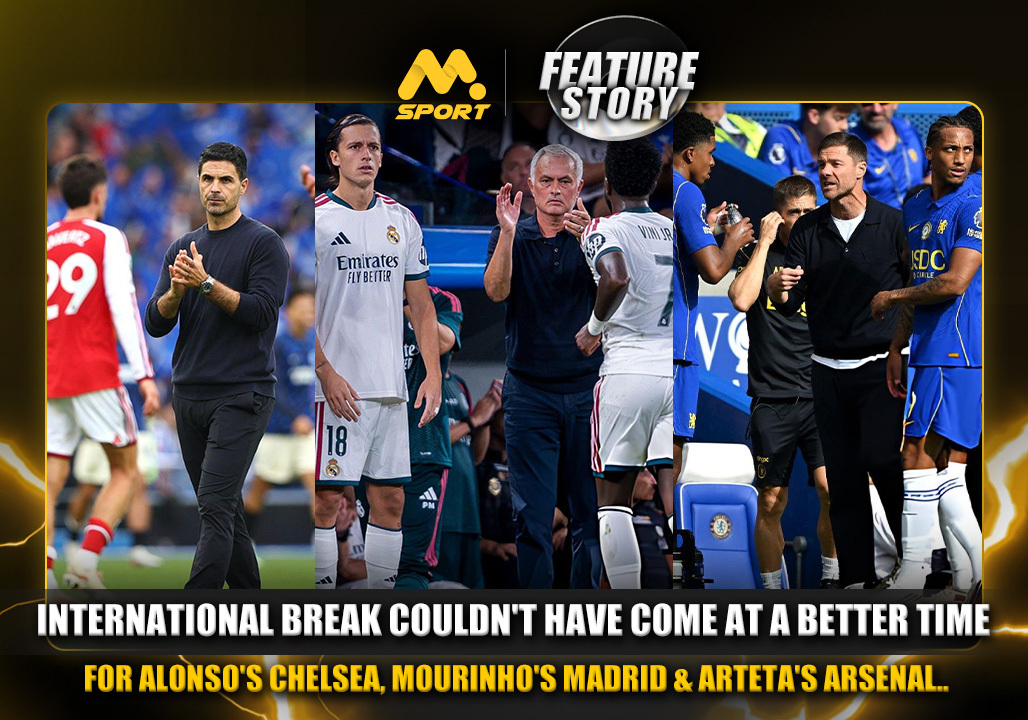
Domestic football has gone dark until 10 October. Not a standard international pause. A FIFA-engineered super-window that fused September and October into one three-week freeze, the longest in-season club gap since Qatar 2022.
For most managers, that is a logistical headache. For three men staring at ugly scorelines, it is a lifeline. These three elite managers inherited the same gift: time.
Xabi Alonso walked into Stamford Bridge this summer as a serial winner from Leverkusen with a bad patch that has been unanimously agreed wasn’t his fault at Real Madrid. José Mourinho returned to the Bernabéu 13 years after he left, on a three-year deal that cost Madrid €15 million to extract him from Benfica.
Mikel Arteta walked into this season as Premier League champion, the first Arsenal EPL title in 22 years, with a new contract already in the drawer. All three have just been punched in the mouth, and all three now have 21 days to stop the bleeding.
Alonso's Chelsea: Rebuild the Spine Before Bournemouth
Seven points from five Premier League games. Tenth in the table. Goal difference minus two.
A 3-0 humiliation at Brentford on 18 September that Levi Colwill called out in public: the second-half collapse was the worst night of Alonso's short Stamford Bridge reign, and it stretched Chelsea's winless run to three.
That is not a slow start. That is a warning flare.
Alonso has been building a side without its engine. Moisés Caicedo had one brief cameo against Brighton this season, then a calf injury that kept him out of Ecuador's Asia trip. João Pedro twisted a knee against Hull, scored anyway, then withdrew from Carlo Ancelotti's Brazil squad.
Reece James is being load-managed. Cole Palmer pulled out of England with a muscular problem. Marco Palestra and Emmanuel Emegha are also in the treatment room.
Here is the gift: as many as 13 first-team players will stay at Cobham. Colwill, already omitted by Thomas Tuchel, has told the squad to use the grass. Alonso can drill the defensive shape that leaked three times at the Gtech, reintegrate Caicedo and Pedro, and finally put a version of his dream XI on the same pitch.
The Pathway: Chelsea return at home to Bournemouth on Saturday, 10 October. The Cherries have three points from five. It is the kind of fixture that either relaunches a season or confirms the panic. Miss it, and the noise around Alonso's methods will not wait for Christmas.
Mourinho's Madrid: Reset Before the 16-Day Gauntlet
Fourth in La Liga. Five wins, two defeats, 15 points. Barcelona sit on 21 from 21, 31 goals scored, seven matches unbeaten.
The gap is six points after seven games, and it opened because Madrid keep dropping away from home: 1-0 at Betis, then 2-1 at the Metropolitano after Dean Huijsen's red card and a penalty, Madrid's first derby loss under Mourinho 2.0, and still without a win at Atlético's ground since 2022.
Vinícius Júnior has one goal in eight appearances and has been substituted in four consecutive matches. Marca has already floated the unthinkable: Mourinho is ready to drop him.
A Champions League 2-1 win over Inter in midweek cannot disguise the midfield imbalance. Madrid are averaging 52.5% possession in the league. Barcelona are at 68.6%.
Mourinho's own words from August now look prophetic: "The international break concerns me. It is a long time." Fifteen players have left for national teams.
The ones who stayed, Courtois, Rüdiger, Militão, Valverde, Tchouaméni, Rodrygo, among them, got four days off after the derby, then individual programmes at Valdebebas. No generic training block. Tailored work. Rest for some, extra sessions for others.
The Pathway: Villarreal at the Bernabéu on 10 October, then Roma away in the Champions League, Sevilla, Leipzig at home, and El Clásico at Spotify Camp Nou on 25 October.
Five matches in 16 days. Eight in a month. If Mourinho cannot use this pause to decide whether Vinícius starts, whether Bernardo Silva sits in the double pivot, and whether the back line can survive without Huijsen's rashness, the title race will be a procession in Catalonia before November.
Arteta's Arsenal: Absorb the Lesson, Then Survive the Blitz
Arsenal were chasing an eighth straight win to open a season, a 123-year club record. They had nine consecutive Premier League victories dating back to April.
They had conceded one league goal in four games. Then Brighton scored three, Pascal Groß, Charalampos Kostoulas and Chema Andrés, and Arteta admitted his champions "didn't respect the game."
It was their biggest Premier League defeat since May 2023. Also against Brighton. The champions sit second, 12 points from five, three behind a perfect Manchester City.
One bad afternoon does not dethrone anyone. Nine games in 28 days after this break just might, if the squad comes back broken.
Seventeen senior Gunners are on international duty, spanning 11 countries. Bukayo Saka, Eberechi Eze, Myles Lewis-Skelly and Ezri Konsa face Spain's David Raya, Mikel Merino and Martín Zubimendi at Wembley.
Gabriel Magalhães and Bruno Guimarães are on a Brazil tour that runs Australia-Australia-India. Kai Havertz, thankfully, is the exception: Jürgen Klopp's Germany split means his last game is 27 September, giving him almost two full weeks at London Colney before Leeds.
Now, we know those are two weeks he will need to get back to fitness after suffering an injury against the Netherlands on September 24, in his first test.
The Pathway: Leeds United at the Emirates on 10 October, then Lille at home in the Champions League three days later. Arteta has already called Brighton a "big lesson."
He has Noni Madueke, Kepa and Illan Meslier on site, plus rehabilitating bodies in Ben White, Piero Hincapié, William Saliba and Cristhian Mosquera.
Declan Rice has already pulled out of England. The window is not just recovery. It is the last clean air before a fixture list that will not breathe again until winter.
Three Managers, One Clock
Alonso needs a functioning defense. Mourinho needs to destroy the hierarchy and get a midfield that can beat a press. Arteta needs legs that can survive October. FIFA handed all three the same 21-day pause, and none of them asked for it until the scoreboard did.
When club football returns on 10 October, the table will still show City on 15, Barcelona on 21, and three famous clubs trying to remember who they were supposed to be. The international break did not save them. It gave them one last chance to save themselves.
🔗Bet Now on MSport
PremierLeague #LaLiga #Chelsea #RealMadrid #Arsenal #XabiAlonso #JoseMourinho #MikelArteta #InternationalBreak #WeAre26 #RoadToTheTitle #FootballNews