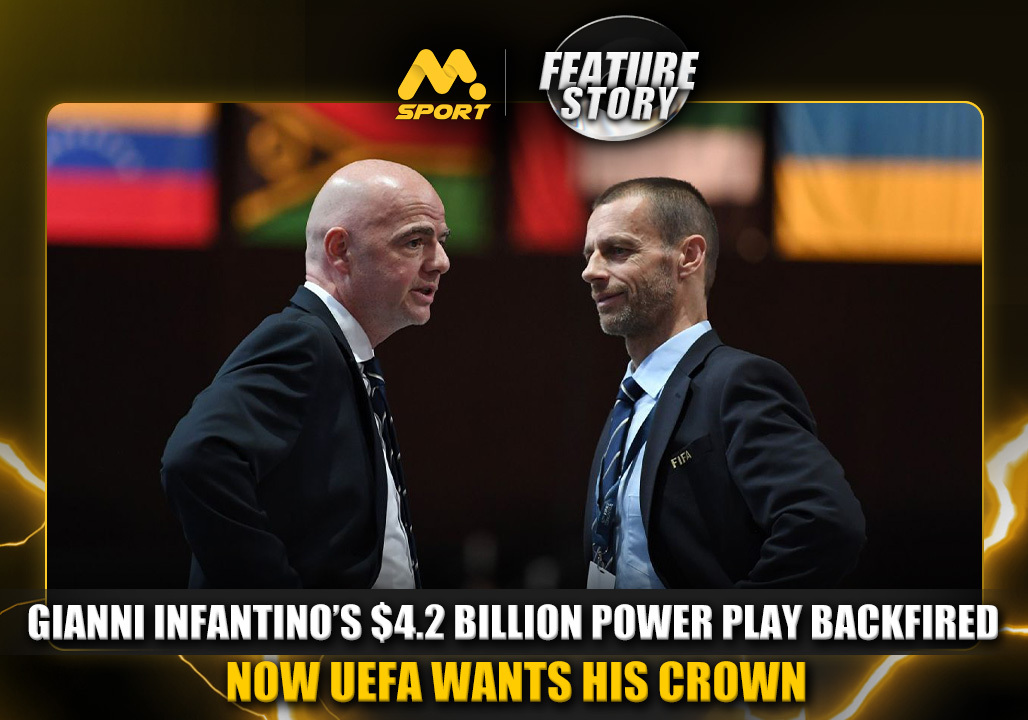
Gianni Infantino began the week attacking FIFA's critics. He ended it facing a World Cup boycott, internal rebellion, possible legal action and an open declaration that UEFA had lost confidence in his leadership.
On Sunday, July 26, Infantino sounded like a man celebrating victory. The biggest World Cup in history had ended a week earlier. Stadiums had been filled, billions had watched, and Spain had been crowned world champions. Infantino used the moment to confront critics, accusing journalists of spreading hate while FIFA worked on the "front lines" of the game. "While you divide, we unite," he declared.
Six days later, the message looked very different. UEFA's 55 national associations had threatened to withdraw from every FIFA competition. CONCACAF and the Asian Football Confederation had joined the resistance. A senior adviser had resigned. Then FIFA abandoned the proposal that had caused it all.
Sunday: Infantino Turns on His Critics
Infantino's message on July 26 did not appear in isolation. The FIFA president had spent much of the World Cup defending decisions that placed the organisation under intense scrutiny, from expensive tickets to compulsory hydration breaks to the outrage after Folarin Balogun's red card was placed on probation following an intervention from US president Donald Trump.
FIFA insisted its disciplinary bodies were independent, but the episode strengthened the impression that Infantino had become too close to political power. His relationship with Trump, whom FIFA had previously presented with a specially created peace prize, raised questions about the organisation's political neutrality.
The tone of his World Cup message suggested he saw the tournament's success as an answer to every criticism. Within 48 hours, a proposal turned years of tension into open revolt.
Tuesday: The $20 Billion Plan Is Revealed
On July 28, FIFA announced its intention to establish FIFA Forward Enterprise, or FFE, a proposed company bringing FIFA's commercial rights and tournament operations, broadcasting, sponsorship, ticketing and licensing, under one subsidiary.
FIFA planned to sell around 20 per cent of the new company to outside investors, raising as much as $4.2 billion based on a $20 billion valuation. Thrive Eternal, connected to Thrive Capital founder Joshua Kushner, brother of Jared Kushner, was expected to lead the investor group. FIFA insisted it would keep majority ownership and control over formats, regulations and the calendar.
The pitch to FIFA's 211 associations was considerable: up to $20 million in additional project funding each, with regular development funding rising from $8 million to $20 million during 2027-2030. For small federations building pitches or funding women's football, that money could be transformative, and it has always been the foundation of Infantino's political strength, since every association holds one vote regardless of size.
The problem was not simply what FIFA wanted to do. It was how far the proposal had progressed before football's most important organisations knew anything about it.
UEFA Reaches for the Most Powerful Weapon It Has
The Asian Football Confederation said it had not been consulted. UEFA and CONCACAF complained they had been blindsided by a plan capable of permanently changing the ownership structure around FIFA's competitions.
On July 30, UEFA stopped asking for explanations and issued an ultimatum. Its 55 associations unanimously rejected the proposal and announced their national teams would not participate in FIFA competitions for as long as the plan remained alive. "The World Cup is not for sale," UEFA declared.
CONCACAF's 41 members also rejected the proposal. The following day the 47-member AFC stood alongside UEFA and CONCACAF. Those three confederations contain 143 of FIFA's 211 national associations. The political arithmetic had become impossible to ignore, and by Thursday night the proposal no longer had a realistic route to majority support.
Friday: FIFA Defends the Plan, Then Abandons It
FIFA initially tried to regain control of the story, blaming "incorrect media reports" and insisting "nobody is selling football." But the resistance was no longer only coming from outside FIFA.
Carlos Cordeiro, one of Infantino's senior advisers, resigned with immediate effect and described the proposal as a bad deal for football. FIFA chief operating officer Kevin Lamour said staff had been deceived and reportedly called FFE a "project of one person."
By Friday evening the fight was over. FIFA announced the proposal would not proceed because it had created divisions no longer compatible with its original objective. A plan that could have reshaped FIFA's business for generations had been announced on Tuesday, defended on Friday morning, and abandoned by Friday night.
UEFA Refuses to Treat the Withdrawal as the End
Infantino might have expected cancelling FFE to calm things. UEFA instead used the withdrawal to widen its attack. On Saturday, European football's governing body said FIFA's current leadership had lost its confidence, demanding an examination of how the proposal was developed and insisting "no option should be off the table."
UEFA argued FIFA, holding more than $5 billion in reserves, could increase development funding without selling part of its commercial operation. "This is a victory for the whole game," its statement said. "But it must not be the end of the story."
UEFA has issued a document-preservation order requiring relevant emails, files and data connected to FFE to be retained, and is reportedly considering legal action, arbitration or regulatory complaints. The dispute has moved from stopping a deal to examining the leadership behind it.
Is Infantino Really in Danger?
Before the World Cup, Infantino's re-election in March 2027 looked almost guaranteed, with more than 200 national associations reportedly having endorsed him. That support cannot now be assumed.
On August 3, Wales became the first association to formally withdraw its endorsement, citing failures in governance, leadership, communication and judgement. UEFA's 55 members are also numerous enough to request an extraordinary FIFA Congress if they stay united, needing just one-fifth of members, currently 43 associations.
But removing Infantino will require more than European anger. He has spent a decade building alliances across Africa, Asia, the Americas and the Middle East, and many associations have received unprecedented funding under his leadership. UEFA would need a credible alternative capable of winning support outside Europe, with candidate nominations closing November 18 ahead of the March 2027 election in Rabat. Without a serious challenger and a cross-confederation coalition, Infantino could survive even after losing Europe's confidence. What has changed is that, for the first time in years, his opponents organised, discovered their power, and won.
A Proposal Has Died, but the Battle Has Only Started
Infantino began the week telling FIFA's critics they had been too consumed by negativity to appreciate the World Cup. He ended it facing a rebellion from the organisations responsible for running football across most of the world.
The immediate proposal has gone, but the questions behind it remain. Who controls FIFA's commercial future? How much authority should belong to its president? Why were the confederations and FIFA Council not involved earlier? Can private investment enter the World Cup without eventually influencing sporting decisions? And does Infantino still command enough trust to lead the answers?
UEFA has made clear it no longer considers the cancellation of FFE sufficient. It wants accountability, reform and possibly a change of leadership. The World Cup was not sold. But the belief that Gianni Infantino could do almost anything with it and remain unchallenged may have disappeared for good.