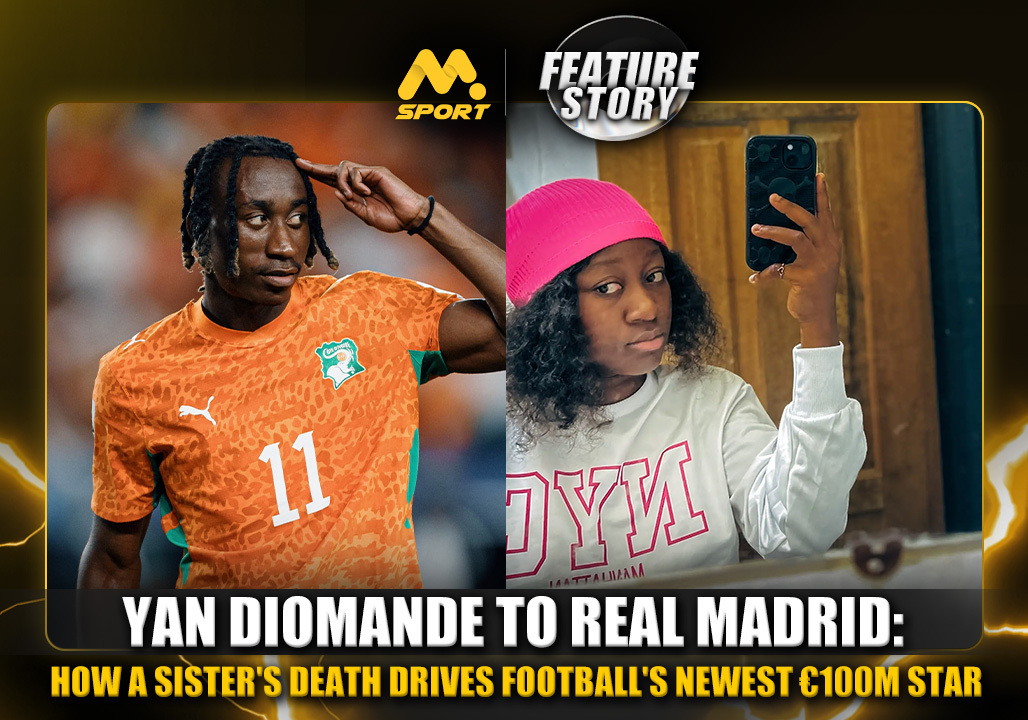
Someone kept calling him from back home. He was annoyed. He didn't understand why they kept calling.
He was a teenager chasing a dream on another continent, far from Abidjan, far from everyone he loved. So when the phone lit up again, and again, he almost didn't answer. Then he picked up. And they didn't even soften it.
His sister Roxanne was gone. Fifteen years old. Her drink had been spiked at a party. In one sentence down a phone line, Yan Diomandé's world stopped turning.
He was a boy with a talent the whole world would soon fight over. But in that moment he wasn't a prospect or a phenomenon or a €100 million name. He was a brother who would never see his little sister again.
The Boy Who Went the Wrong Way
Here's the thing about Diomandé's story that nobody expects. He didn't take the usual road out of Africa.
Most Ivorian prospects dream of Europe, of a French academy, of Ligue 1. Diomandé went to America. A kid from Abidjan ended up in Yulee, Florida, playing high-school soccer for the Hornets, then joining DME Academy and winning a regional title in a league most football fans have never heard of. Eighteen months ago he was in the Florida Central Premier Division. Let that sit for a second.
From Florida he went to Leganés in Spain, a modest club, for €20m. Then RB Leipzig activated a release clause and Red Bull's scouts, by their own admission, were stunned by what they'd found. Twelve Bundesliga goals later, the whole of Europe was paying attention.
It is one of the strangest, most unlikely paths to the top the modern game has produced. Abidjan to Florida to Spain to Germany, and now to the Santiago Bernabéu. No blueprint. No shortcut. Just a boy who kept moving until the world caught up with him.
The Letter to His Sister
Two years after that phone call, Diomandé did something most 19-year-olds never could. He wrote to his dead sister, in public, for the world to read, in The Players' Tribune.
It was not a footballer's press release. It was raw grief with the skin peeled back. He described a numbness that had swallowed him whole, a young man who felt he'd stopped being human at all.
"I used to have emotions," he wrote. "Now, I don't feel anything. It's like I'm not even human. Since you died, I'm just blank."
There is no statistic for that. No transfer fee heals it. A teenager who had every gift football could offer was telling the world that the one thing he wanted back was the one thing money would never buy.
The Promise That Drives Him
But the letter didn't end in the dark. Buried in the grief was a vow, and it is the reason this whole story matters.
Diomandé decided his pain would have a purpose. If he couldn't feel, he would work. If he couldn't bring Roxanne back, he would carry her name so far and so high that the world would have no choice but to learn it.
"All I can do is use the pain to work harder, and to do everything we dreamed about," he wrote. "I want you to know that I will make sure that you live on. I will make sure that everybody knows your name. The whole world. Everything I do on a football pitch, it's for you."
Read that again. Everything I do on a football pitch, it's for you. Every goal at Leipzig. Every run at the World Cup for the Ivory Coast. Every one of them addressed to a fifteen-year-old girl in Abidjan who never got to see any of it.
€100 Million and the Walk Into the Bernabéu
On July 26, 2026, Fabrizio Romano typed the three words that change a footballer's life. Here we go. Real Madrid had agreed a deal worth over €100 million, beating PSG, Liverpool and Manchester City to the signature of a 19-year-old.
It makes Diomandé one of the most expensive signings in the history of the biggest club in the world, sitting behind only Bellingham and Hazard in Real Madrid's all-time list, ahead of Bale, ahead of the fee they paid for Cristiano Ronaldo. A five-year contract to 2031. A boy from Abidjan, via a Florida high school, walking into the Santiago Bernabéu.
The numbers are staggering. But the number that matters isn't the fee. It's the promise underneath it. When Diomandé pulls on that white shirt, he won't just be carrying the weight of the badge. He'll be carrying Roxanne, exactly as he swore he would.
What This Means for Every Kid Watching
There's a boy in Accra right now kicking a ball against a wall. A girl in Kumasi. A kid in a dusty compound in Abidjan who has never left his neighbourhood. And they need to hear this.
Five years ago, Yan Diomandé was nobody the scouts had circled. He wasn't in a famous academy. He wasn't even in Europe. He was a teenager who had lost his sister and could have let the grief bury him. Instead he turned it into fuel, and in the space of a few years he went from a Florida high-school pitch to the most glamorous club on earth.
That's the lesson African football keeps writing, over and over, and it's worth saying plainly. Talent here is not smaller than talent anywhere else. The dream is not less real because of where you were born. Diomandé is proof that the distance between a compound in Abidjan and the Bernabéu is not as far as they told you it was.
He carried unbearable pain and refused to let it be the end of his story. If he can do that, the kid against the wall can dream too.
Sometimes the Biggest Trophy Is the Promise You Keep
Yan Diomandé is 19 years old. He has more money and fame arriving than most people see in a lifetime, and he'd trade a good portion of it, you suspect, for one more afternoon with his sister.
He can't have that. What he can do is exactly what he promised in that letter: make the whole world know her name. And now, as a Real Madrid player on the biggest stage football has, he's about to.
Every goal he scores in white will be for a fifteen-year-old girl in Abidjan. Roxanne Diomandé never got to grow up. But because of the brother who refused to break, the world is going to remember her anyway.
Sometimes the biggest trophy isn't the one you lift. It's the promise you keep.