On Monday, September 22, 2025, in Paris, Ousmane Dembélé stood on stage and lifted the 2025 Ballon d'Or. The room was full of the world's finest footballers. Cameras flashed. The applause was deafening. And then he started to speak — and the voice that had said nothing particularly profound in a thousand post-match interviews cracked open completely.
He wasn't crying about the trophy. He wasn't crying about the goals, the titles, the Champions League, or the long road from a council estate in Normandy to the summit of world football. He was crying about a man sitting in the audience. A man who has never played a minute of professional football at the highest level. A man most people in that room had never heard of.
Moustapha Diatta sat next to Dembélé's mother, Fatoumata, and his agent, Moussa Sissoko. And when Ousmane's voice broke on that stage, the camera found Moustapha's face — and he was gone too. Tears running down his cheeks. Not the tears of a fan watching his hero. Something deeper. The tears of someone who had been there for all of it, every ugly and beautiful chapter, and had never left.
This Ballon d'Or was not just a football award. It was a tribute to loyalty, to brotherhood, to a promise made in childhood and fulfilled under the bright lights of Paris.
Two Kids, One Building, One Dream
The story begins in Évreux, a modest city in Normandy, about 100 kilometres west of Paris. Not exactly the kind of place that produces Ballon d'Or winners. But then again, greatness rarely announces its postcode in advance.
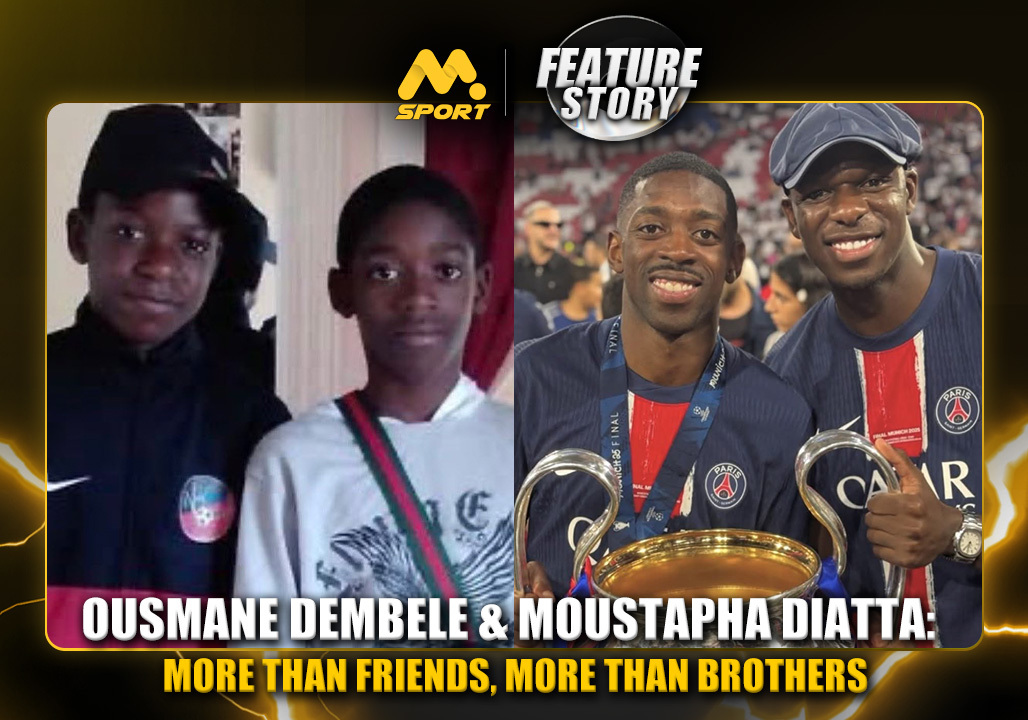
Dembélé and Diatta grew up inseparable in the same block of flats on the "la Plaine" council estate — Dembélé on the fifth floor, Diatta on the first. They formed a bond in the La Madeleine neighbourhood that has never wavered. At all hours, the pair played football with now-Bayern Munich centre-back Dayot Upamecano, who lived across the road, on a little concrete square using benches as goals, or against the wall.
Think about that image for a moment. Three boys on a concrete square in Normandy. One of them would become the best player on the planet. One would become a Bundesliga and Champions League winner with Bayern Munich. And one — Moustapha — would quietly give up his own football dreams to make sure the other two weren't lonely on the way up.
Both boys joined local club ALM Évreux, where Diatta played as a central defender, forming a partnership at the back with Upamecano. He was good. Genuinely promising. He went on to join the Stade Malherbe de Caen academy before continuing a quieter career that included a spell in Spain with CE L'Hospitalet. Football had a place for him too — just not the one the world was watching.
His playing career ended in 2019. But his friendship with Dembélé didn't end. It got stronger.
The Facebook Comment That Said Everything
Fifteen years ago, Ousmane Dembélé was nobody. Just a kid posting photos on Facebook the way teenagers do — hoping someone would notice, half-expecting no one to.
The comments section was empty. No friends, no family, no likes. Except for one person.
Moustapha Diatta.
He had written: "We will remain friends until I see you at the top, because I am sure that one day you will be the best."
Not "good luck." Not a thumbs-up emoji. A prophecy. Written by a child on a social media page that nobody else cared about. And he meant every word of it.
Years later, that screenshot went viral. Because sometimes the internet stumbles onto something real and doesn't quite know what to do with it.
Following Him Across Borders
When Dembélé's talent took him from those concrete pitches to Stade Rennais at 17, it was the beginning of a journey that would eventually cross several countries and cost over €100 million in transfer fees. But no fee was ever paid for Moustapha's loyalty. It just came.
He put his own career aside to follow Dembélé, support him, and remind him of where he came from. When Rennes led to Borussia Dortmund and a new life in Germany, Dembélé could have gone alone. He didn't have to. Diatta followed him there, and later to Barcelona, where in the club environment he became much more than a friend — a confidant, a protector, and an organiser, someone who ensured Dembélé could focus on his game while having a steady support system by his side.
That is not a small thing. Football at the elite level is brutally isolating. Young men arrive in foreign cities with no language, no culture, no context. They are surrounded by people who want things from them — agents, sponsors, journalists, hangers-on. Finding someone who simply wants you to be okay is rarer than any trophy.
Ousmane had that. He had always had that. And Moustapha had crossed borders to make sure it stayed true.
The Barcelona Years — Surviving Together
Barcelona is where the story gets difficult. Dembélé's time at Camp Nou was, for long stretches, a story about wasted potential. Injuries piled up. Controversies followed him. The weight of that €105 million price tag sat heavy on a young man's shoulders, and the Spanish press was never kind when he stumbled.
He confessed, at some point, that he would come home from games and cry alone.
Then Moustapha moved in.
No more lonely nights. No more sitting with the silence of a bad game and no one to share it with. In moments of doubt, injury, or loneliness, Moustapha was that shadow brother — always present, always loyal.
Those closest to Dembélé describe the friendship in specific terms. They call it "sincere, transparent, and selfless" — a rare example of childhood loyalty that has lasted into the elite world of professional football. In a world full of people who perform friendship for proximity to fame, that description carries real weight.
PSG, Adidas, and a New Chapter Together
The move to Paris Saint-Germain changed everything. Under Luis Enrique, Dembélé was reinvented. When Dembélé needed freedom to match his fluidity with the structure of the Spaniard's tactics, he got it. When he needed support and trust, he got it. The goals came. The performances came. And with them, the recognition that had always felt just out of reach suddenly arrived — all at once.
In PSG's 5-0 Champions League final win over Internazionale, his eyes locked on goalkeeper Yann Sommer became a viral moment that symbolised his determination and completed his transformation.
Through all of it, Moustapha was there. At the matches. In the dressing room corridor. At the dinner table. He attends nearly all of his friend's matches, keeping his role as a steadfast presence intact.
And when the brand deals came — the ones that come with being the best player in the world — Dembélé didn't leave his friend behind. Adidas launched the "You Got This" campaign, showcasing the Dembélé-Diatta duo in their hometown of Évreux. Two kids from the council estate, back where it started, fronting a global campaign. Not because Moustapha was famous. Because he was real.
Meanwhile, Diatta has carved out his own path — exploring business ventures including a watch shop, pursuing acting training, and moving between Paris, London, Dubai, and Marrakech. He is not a footnote to someone else's story. He is his own man. He just chooses, still, to be present for his brother.
The Moment at the Ballon d'Or
Dembélé knew the tears would come, inevitably. In the days before the ceremony, he thought long and hard about what would happen if his dream of winning the 2025 Ballon d'Or became reality. He talked about it many times with Moustapha. They both knew. So when the moment finally arrived, they were ready — and completely unprepared at the same time.
Dembélé arrived at the ceremony with Diatta, and like family, Moustapha was part of the photo with Mama Dembélé. Not a guest. Not a plus-one. Family.
When Ousmane spoke, he looked into the crowd. He found his mother. He found his friend. And then the words came — simple, unpolished, utterly true:
"Since we were 4 or 5 years old, we've done everything together, lived through everything. He has always supported me, and until the end we will be together, him and me."
Moustapha broke down in tears. And sitting close by was Fatimata Dembélé, Ousmane's mother. When Ousmane ended his speech, she rose from her seat and walked onto the stage. The audience held its breath as she wrapped her son in a long embrace. One a brother in spirit, the other a mother in blood, both part of the journey that turned a boy from Évreux into the best in the world.
What This Story Is Really About
In football, we talk endlessly about talent. We build statues to it. We pay nine-figure sums for it. We debate it on television for hours. But talent is easy to spot. What's hard to spot — what cameras almost never find — is the invisible scaffolding that holds a gifted person together when everything is falling apart.
For Ousmane Dembélé, that scaffolding has always had a name.
The Facebook comment from a boy who believed before anyone else did. The decision to cross into Germany so his friend wouldn't be alone. The nights at Camp Nou when the game had gone badly and someone was still waiting at home. The concrete square in Évreux with benches for goalposts and a future Ballon d'Or winner dribbling past a future Bayern Munich defender while a third boy just tried to keep up — not for football, but for friendship.
This was never really a football story. It's a story about what it means to choose someone. Again and again, across cities and countries and years, in the good days and the hard ones. To show up not because the spotlight is on, but because it isn't.
When Ousmane Dembélé lifted the golden ball, the world saw one man crowned. But on the fifth floor of a council block in Évreux, a long time ago, there were two boys who made a quiet promise to each other.